
When we picture the place of film within the creative industry, we most commonly imagine Hollywood, it encapsulates the idea of place and film through its image, being known most prevalently for its film industry. Film is without a doubt linked within the creative industries, by using the example of a place of film (Hollywood) we can understand, through a geographical lens, how place is important within the creative industries and why. Apart from where film is made and where it is seen, what other aspects of the place of the film industry can we unpack?
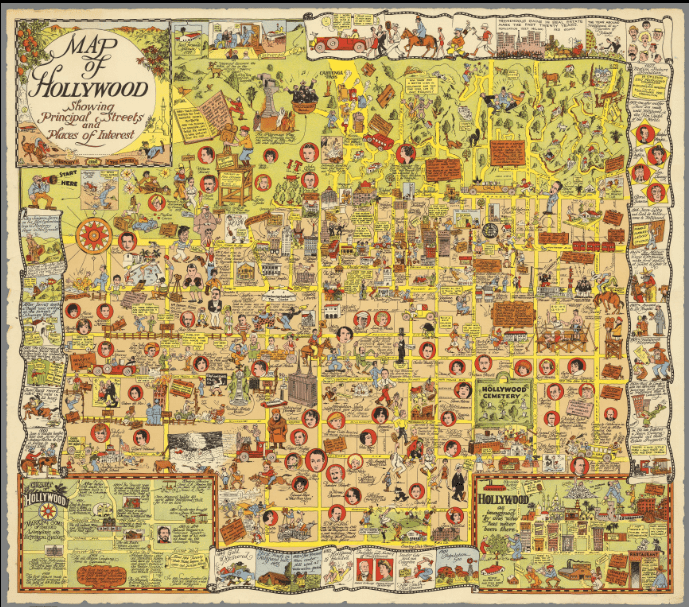
Geography has a longstanding relationship with visual culture and imaginaries (MacDonald, 2006). By looking through imaginaries, using the example of Hollywood, we can explore the importance of place within the creative industries. In his seminal work Orientalism, Edward Said argued that spatial imaginaries are ways of representing and talking about places (Said, 2003). These imaginaries are created and represented through images, such as film, and can shape how people see and understand certain places/spaces and people. Bleiker, (2018) a prominent visual geographer, also suggests that visuals can help shape our understanding of place.
Place is undoubtedly important in the creative industries and has been said to have made a significant difference to where these industries/people choose to situate themselves (Drake, 2003). By looking through the geographical lens of the perception of the ‘imagined’ Hollywood, we can begin to understand that, how people imagine this place to be, can have an effect on the creative industries it can attract.

Hollywood has benefited from the imagined ‘place’ of the film industry, many of its creative industries are based around this imaginary and its association with film. As a result, it is also attractive to tourists because of these factors, and therefore provides a flourishing and successful base for the creative industries.
Hollywood is not the only place that has shown this, for example, Les Roberts (2012) within his book on ‘A Cinematic Geography of Liverpool’ discusses the power of the imagined within Liverpool. Suggesting that for some Liverpool is just a place, but for others, the imagined Liverpool conjures up images of the ‘city-film’, associated with the films and feature shots that were created there. Therefore, proving that through the geographical concept of the imagined, we can begin to understand how certain places attract creative industries, and can actively help to promote them.
So, we have explored, using the example of Hollywood, ways in which we can discuss the topic of place through a geographer’s lens. Once again, through the perspective of a geographer of the creative economy, we can understand the place of a creative industry in ways that transcend far further than the marking point on a map.
References
Bleiker, R. 2018. ‘Mapping Visual Global Politics’ in R. Bleiker (ed) Visual Global Politics. Routledge, London.
Drake, G. (2003). ‘This place gives me space’: place and creativity in the creative industries. Geoforum, [online] 34(4), pp.511-524. Available at: https://www.sciencedirect.com/science/article/pii/S0016718503000290.
(Figure 2) EarthlyMission (2020). Cool Vintage Map of Hollywood. [image] Available at: https://www.earthlymission.com/cool-vintage-map-of-hollywood/ [Accessed 19 Feb. 2020].
(Figure 1) FodorsTravel (2020). Hollywood sign. [image] Available at: https://www.fodors.com/world/north-america/usa/california/los-angeles/experiences/news/the-once-and-future-hollywood-how-to-experience-tarantinos-golden-age-of-los-angeles [Accessed 19 Feb. 2020].
MacDonald, F. 2006. ‘Geopolitics and ‘the vision thing’: regarding Britain and America’s first nuclear missile’ Transactions of the Institute of British Geographers 31, 53-71
Roberts, L. (2012). Film, mobility and urban space: A Cinematic Geography of Liverpool. Liverpool: Liverpool University Press.
Said, E. (2003) Orientalism. Revised ed. London: Penguin Classics.
(Figure 3) WSUOnline (2020). Film Analysis. [image] Available at: https://weber.instructure.com/courses/423843/pages/film-analysis [Accessed 20 Feb. 2020].
 Geographies Of The Creative Industries